
Weather-based forecast correctly selected 55 of 90 winners and called The Citadel’s improbable upset of Charlotte…
SwampButt Scale of Sultry Sweats Out a 61% Win Rate in College Football’s Scorching Week 1
LAKE JACKSON, Texas — The SwampButt Underwear Scale of Sultry is a college football prediction model that ignored rankings, betting lines, coaching, injuries and player talent correctly selected 55 of 90 Week 1 winners. The SwampButt Underwear™ Scale of Sultry ffinished the first full week of the 2026 college football season with a 55–35 record—61% accuracy—after making every selection using one deliberately narrow variable: which team was accustomed to the hotter and more humid home environment.
The Scale’s most remarkable correct selection was The Citadel’s 43–41 victory over Charlotte. The Scale chose The Citadel even though the Bulldogs closed as approximately 20½-point underdogs with a Moneyline near +950. In other words, the conventional market considered a Citadel victory highly unlikely.
The Scale also correctly selected Tarleton State, a two-point underdog, to defeat Bowling Green. Tarleton State won 20–13. Neither selection was based on a roster evaluation, statistical match up or assessment of coaching. The Scale simply favored the school whose players were accustomed to the more sultry home-campus conditions.
“The Scale is intentionally incomplete as a football prediction model,” said Harold Nicoll, owner and inventor of SwampButt Underwear and the man who developed the Scale of Sultry. “It does not know who has the better quarterback, offensive line or coaching staff. We wanted to isolate one question: During the first weeks of the season, do players accustomed to hotter and more humid environments have a conditioning advantage?”
The Week One results do not prove that heat acclimation determined the winners. They do, however, provide a surprisingly strong opening result for a forecast based on one environmental variable.
Featured Games Support the Premise
Among the Scale’s featured games, Miami defeated Stanford 45–6, Houston defeated Oregon State 33–20, Alabama defeated East Carolina 48–10, Auburn defeated Baylor 17–16 and Florida defeated Florida Atlantic 66–21. All five were correctly selected by the Scale.
Colorado’s 14–13 victory over Georgia Tech was the only loss among the six featured games with recorded predictions. SMU subsequently defeated Florida State 27–24, but the frozen Scale prediction for that Monday game is unavailable and is not included in the 55–35 record.
The Houston and Alabama games supplied some of the clearest evidence that heat influenced how the teams prepared and played.
At Houston’s noon game against Oregon State, the Houston Chronicle rreported a feels-like temperature of 100 degrees at kickoff. Conditions remained steamy even after a brief downpour.
Houston used its cooling truck and rotated 23 players on defense. Coach Willie Fritz connected that unusually deep rotation directly to the conditions.
“We played a lot of guys,” Fritz said. “You’ve got to do that early in the season, especially when it’s hot.” Fritz also described the conditions as typical for Houston in early September and said his team handled them “pretty good.” The heat-acclimated Cougars won 33–20.
At Alabama, the temperature was in the 90s and the heat index exceeded 100 degrees during the Crimson Tide’s 48–10 victory over East Carolina. Alabama reportedly kept more than 30,000 pounds of ice on the sideline, equipped its injury tent with air conditioning and had players consuming 10 to 15 bottles of water during the day. Alabama coach Kalen DeBoer said he knew of only one Crimson Tide player experiencing a cramp. He credited the team’s preparation and a hot preseason camp. East Carolina coach Blake Harrell acknowledged a different experience. “We probably let the heat affect us more than we let it affect them,” Harrell said.
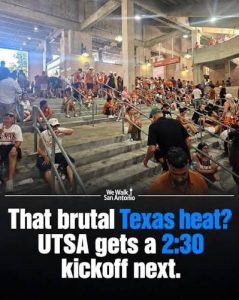
That does not establish heat as the reason Alabama won. It does, however, express the Scale’s underlying premise almost perfectly: the same conditions may not affect two teams equally. But the temperature at game time set a record for Alabama football. Records are made to be broken in football stadiums, and not just on the field. The temperature at Bryant-Denny Stadium reached a record-setting 99 degrees during the Crimson Tide’s season opener against East Carolina on Saturday, according to ABC 33/40 chief meteorologist James Spann. There were 200 emergency calls and 15 ambulance runs at the Alabama game because of heat.
Week One Was Sultry—and Sometimes Dangerous
The Scale of Sultry was originally created for people attending college football games to describe what heat, humidity, sunlight and limited evaporation meant for personal comfort. During Week One those conditions affected far more than underwear.
The Indiana State–Purdue game received the highest Week 1 game-site Sultry Score at 8.9 on the 10-point scale. Other exceptionally sultry forecasts included Louisiana–Lamar at 8.0, East Carolina–Alabama and Merrimack–Delaware at 7.9, Youngstown State–Kentucky at 7.7, and Oregon State–Houston at 7.6.
Across the country, extreme heat affected players, coaches, bands, spectators and even the length of games. Emergency responders handled approximately 200 heat-related calls inside and outside Neyland Stadium during Tennessee’s game against Furman. Fifteen people were transported by ambulance. Kentucky reported 100 heat-related medical calls during its home opener against Youngstown State. At Illinois, emergency medical personnel treated 24 people, with approximately 90% of those cases attributed to heat.
At Alabama, spectators were reportedly removed from Bryant-Denny Stadium on stretchers while ambulances waited outside. By the second half, approximately half the crowd had left; the student section was reported to be only about one-quarter full by the fourth quarter.
The fourth quarter of South Carolina’s game against Kent State was shortened because of the extreme conditions. A Division II game between Colorado School of Mines and Washburn ended in a 16–16 tie when officials canceled overtime with the heat index around 107 degrees.
At Iowa’s game against Northern Illinois, the Hawkeye Marching Band canceled its halftime performance. Band member Derek Phillips suffered sudden cardiac arrest after collapsing and was transported to University of Iowa Health Care, where he later died. Temperatures reached 94 degrees, although the university has not established that heat caused the cardiac arrest.
These reports do not form a complete national count. Universities, stadium medical operations, ambulance providers and hospitals use different reporting practices, and many incidents treated inside stadiums never become public. The documented total should therefore be understood as a minimum rather than a comprehensive accounting.
The Scoreboard Told Only Part of the Story
The scoreboard measured who won. The Scale of Sultry also measured what every person inside the stadium had to overcome. Week 1 demonstrated that heat and humidity can affect personnel rotations, hydration strategies, medical preparations, halftime performances, crowd behavior and whether a game can be completed under its normal rules.
The Scale remains a science-adjacent informational and entertainment tool—not a betting recommendation or official weather-warning system. Its 55–35 Week 1 record does not prove that sultriness caused any particular result. It does provide a reason to continue testing the proposition.
A 61% success rate from a model that knows nothing about football except where the teams live is, at the very least, difficult to ignore.
For journalists and broadcasters, the Scale provides a visual, easily explained supplement to conventional game previews—particularly for games involving teams traveling between substantially different climates. “Everyone understands that playing football in heat and humidity is difficult,” Nicoll said. “The more interesting question is whether one team has been living and practicing in those conditions while the other has not. That is the question the Scale of Sultry attempts to answer.”
Scientifically Adjacent, Intentionally Entertaining
The Scale of Sultry is a weather-based novelty prediction and is not a betting recommendation. Forecasts can change, and weather represents only one of many factors that may affect a football game.
The system is intentionally entertaining, but the underlying subject is legitimate. Heat, humidity, solar exposure and the body’s ability to dissipate heat can affect comfort, fatigue and physical performance.
The Scale of Sultry converts those conditions into a simple format that fans can understand without studying meteorological tables or advanced sports analytics.
“If the prediction is correct, we will discuss climate conditioning and the brilliance of the model,” Nicoll said. “If it is wrong, we will remind everyone that we sell underwear.”
About SwampButt Underwear
SwampButt Underwear™ is a real company with a product that helps solve a problem, that being visible sweat on a man’s backside. SwampButt Underwear is for people who experience excessive perspiration, uncomfortable dampness and visible butt sweat. The company’s performance underwear is designed to move moisture away from the skin, dry faster than traditional cotton underwear and reduce the discomfort associated with heat, humidity and physical activity.
SwampButt Underwear is based in Lake Jackson, Texas. SwampButt Underwear™ is a registered trademark in the United States and other countries.