The SwampButt Underwear Scale of Sultry’s Week 5 recap looks beyond the final scores to the conditions fans endured.
October 5, 2026 — The SwampButt Underwear Scale of Sultry picked more winners than losers in Week 5 of the college football season—barely. Its weather-based selections finished 30–29, bringing the season’s cumulative record to 209–179.
But the weekend’s more compelling story unfolded in the stands. At USC and Houston, heat made water, shade and opportunities to cool down an essential part of the game-day experience.

The SwampButt Underwear Scale of Sultry combines temperature, humidity, sunlight and estimated drying conditions to describe the environment at kickoff. It also compares conditions around each team’s campus with those at the game site to explore whether familiarity with heat and humidity might offer a competitive advantage.

The predictions remain an experiment. For fans, however, the conditions matter regardless of who wins.

It Never Rains in Southern California—but It Sure Gets Hot
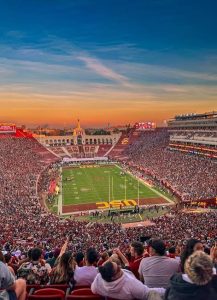
USC and Washington kicked off October 3 at the Los Angeles Memorial Coliseum in 98°F heat. USC’s official postgame notes identify it as the hottest game at the Coliseum since a similarly hot matchup against Western Michigan in 2017. Reporting by The Seattle Times, republished by The Spokesman-Review, described it as tied for the hottest game in Washington football history.
USC vs Washinton and SwampButt Underwear.
USC rallied from a 21–10 deficit to win 25–21. The temperature provides useful context, but it does not establish why the game turned.
The conditions were, as SwampButt Underwear spokesman Nick Heraldson put it, “not proof that heat alone caused the USC comeback or the Washington collapse.”
For spectators, the Coliseum’s limited shade makes hot afternoons especially challenging. Earlier this season, stadium officials announced a range of measures for another high-temperature game. Those provisions illustrate how much preparation can go into helping fans manage the heat:
• Water access: Non-metallic bottled water was permitted, along with empty, refillable non-metallic bottles. Refilling stations were available near concourse restrooms.
• Ice and cooling: Permanent concession stands offered free cups of ice, entrance gates had cooling fans, and Guest Experience locations supplied bags of ice.
• Places to escape the sun: A seated shade tent was available near First Aid Gate 1, with additional shaded areas at Heritage Concourse and Olympic Plaza.
• Medical assistance: First Aid stations were located at Gates 1 and 16.
These measures were reported for the August season opener; they should not be read as confirmation of every provision available for the October 3 Washington game.

Houston: A Comeback on the Field, Cooling Measures for the Fans
Houston’s 27–17 victory over UCF supplied another dramatic comeback. The Cougars erased a 17–0 deficit at TDECU Stadium, scoring 27 unanswered points to win.
Before the 11 a.m. kickoff, Houston Athletics activated its heat management plan because of forecast high temperatures. Fans could bring one factory-sealed water bottle or one empty bottle, provided it met the university’s clear-plastic, non-insulated requirements. Large water dispensers were placed in the student tailgating area and inside the stadium, with cooling fans throughout the concourse.

Those preparations speak to a part of football that a kickoff temperature cannot fully describe. Fans experience the day from the parking lot to the final walk back to the car. Tailgating, security lines and hours in exposed seats all belong in the picture.
Heraldson emphasized that the fan experience begins well before the first play. Once spectators leave their cars, the walk to the stadium can become the first stretch of a long, uncomfortable afternoon.

The physical strain also appeared on the field. UCF quarterback Keyone Jenkins briefly left the game, and coach Scott Frost subsequently confirmed that he had been cramping. That is a documented player issue, although the report does not establish heat as its sole cause.

The Final Score Tells Only Part of the Story
USC and Houston both delivered comeback victories. Their fans also had another concern: getting through the afternoon comfortably enough to enjoy the football.
That is where the Scale of Sultry can contribute to the conversation. Alongside its winner predictions, it can draw attention to the conditions spectators should anticipate and the preparations schools make to help them.
Water access, shade, cooling stations and clear information deserve a place in the game-day story. A thrilling fourth quarter is even better when fans can stay in their seats to see it.

About SwampButt Underwear
College football is awesome. Sweaty underwear is not.
SwampButt Underwear makes moisture-wicking men’s underwear for hot, humid and sweaty days—from the tailgate to the final whistle. When sweat runs between your butt cheeks and threatens to leave an “ass print” on the seat, it is time to rethink traditional cotton underwear. SwampButt Underwear is a Lake Jackson, Texas-based men’s underwear brand designed to help manage moisture and improve comfort in hot, humid conditions.
SwampButt Underwear™ is a real company with a product that helps solve a problem, that being visible sweat on a man’s backside. SwampButt Underwear is for people who experience excessive perspiration, uncomfortable dampness and visible butt sweat. The company’s performance underwear is designed to move moisture away from the skin, dry faster than traditional cotton underwear and reduce the discomfort associated with heat, humidity and physical activity.
SwampButt Underwear™ is based in Lake Jackson, Texas. SwampButt Underwear™ is a registered trademark in the United States and other countries. We paid a lot for it so only use it with permission.

Enjoy the game. Leave your mark on the cheering—not the upholstery.