
SwampButt Underwear Scale of Sultry Week One
Heat Sent Fans to Hospitals, Changed Games and Emptied Stadiums.
Week One Was Sultry—and Sometimes Dangerously Hot
The SwampButt Underwear Scale of Sultry Predicted That From Austin to Knoxville, extreme conditions affected spectators, players, bands and even how long games were allowed to continue.
September 9, 2026 (Lake Jackson, TX) – The SwampButt Underwear Scale of Sultry was originally created for college football fans attending games to describe what heat, humidity, sunlight and limited evaporation mean for personal comfort and how soggy their backsides were likely to be. During Week One, those conditions affected far more than underwear.
A National Weather Service map for Saturday, Sept. 5, showed temperatures near or above 100 degrees across much of the central and southern United States. The Indiana State–Purdue game received the highest Week 1 game-site Sultry Score at 8.9 on the 10-point scale. Other exceptionally sultry forecasts included Louisiana–Lamar at 8.0, East Carolina–Alabama and Merrimack–Delaware at 7.9, Youngstown State–Kentucky at 7.7, and Oregon State–Houston at 7.6.
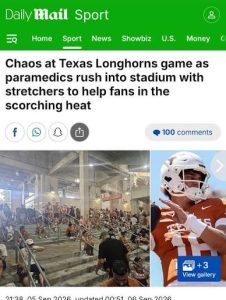
Conditions were especially severe during Texas’ 59–7 victory over Texas State in Austin. The temperature reached 102 degrees, with a reported feels-like temperature of approximately 104 to 105. A widely circulated photograph showed spectators crowded beneath the stadium seeking shade. One attendee described “so many heat casualties” and compared the concourse to a hurricane shelter. Another student, who ordinarily remained until the final whistle, said he left early after feeling his body overheating.
Austin-Travis County EMS transported 13 people from the game to local hospitals. At least three transports were identified as heat-related, while others involved mixed symptoms. University officials provided 16 free hydration stations and four cooling stations, but large portions of the stadium—including sun-exposed student sections—offered little or no shade.
The conditions renewed questions about scheduling early-season games during the hottest part of the day. ESPN selects the broadcast times, according to local reporting.
Similar scenes unfolded elsewhere. Emergency responders handled approximately 200 heat-related calls inside and outside Neyland Stadium during Tennessee’s game against Furman, transporting 15 people by ambulance. Kentucky reported 100 heat-related medical calls during its home opener against Youngstown State. At Illinois, emergency medical personnel treated 24 people, with approximately 90% of the cases attributed to heat.
At Alabama, spectators were reportedly removed on stretchers as ambulances waited outside Bryant-Denny Stadium. By the beginning of the fourth quarter, the student section was estimated to be only about one-quarter occupied.
The effect extended beyond spectators. South Carolina and Kent State shortened the fourth quarter of their game. Colorado School of Mines and Washburn canceled overtime when the heat index reached approximately 107 degrees, producing a rare 16–16 tie. Iowa canceled its marching band’s halftime performance during one of the hottest home games in school history.
The scoreboard measured who won. The Scale of Sultry also measured what every person inside the stadium had to overcome. Despite the medical emergencies and widespread criticism generated by Week One’s afternoon heat, Texas State will return home to face UTSA at 2:30 p.m. Saturday—another early-season Texas kickoff that the Scale of Sultry will be watching closely.
Scientifically Adjacent, Intentionally Entertaining
The Scale of Sultry is a weather-based novelty prediction and is not a betting recommendation. Forecasts can change, and weather represents only one of many factors that may affect a football game. The system is entertaining, but the underlying subject is legitimate. Heat, humidity, solar exposure and the body’s ability to dissipate heat can affect comfort, fatigue and physical performance.
The Scale of Sultry converts those conditions into a simple format that fans can understand without studying meteorological tables or advanced sports analytics.
“If the prediction is correct, we will discuss climate conditioning and the brilliance of the model,” Nicoll said. “If it is wrong, we will remind everyone that we sell underwear.”
About SwampButt Underwear
SwampButt Underwear™ is a real company with a product that helps solve a problem, that being visible sweat on a man’s backside. SwampButt Underwear is for people who experience excessive perspiration, uncomfortable dampness and visible butt sweat. The company’s performance underwear is designed to move moisture away from the skin, dry faster than traditional cotton underwear and reduce the discomfort associated with heat, humidity and physical activity.
SwampButt Underwear is based in Lake Jackson, Texas. SwampButt Underwear™ is a registered trademark in the United States and other countries. We paid a lot for it so please do not use it without permission.