
The SwampButt Underwear Scale of Sultry Fans in the Stands
What College Football’s Hot September Is Teaching Us About the Fan Experience and SwampButt Underwear
September 28, 2026 – A college football final score tells us who won. It does not tell us why a fan left before halftime, why fans are gathered underneath the stands and not in them, why a marching band needed a cooling break or how many spectators finished their afternoon in a hospital.
As we complete Week 4 of the SwampButt Underwear Scale of Sultry, those experiences on and off the field deserve more attention. September’s reporting documented heat-related illness, emergency medical responses and fans retreating from sun-exposed seats. For some people, enduring the weather became a bigger concern than following the game. “Houston fans were bemoaning the specter of an 11:00 a.m. kick off in the heat of the day for their October 3 game against UCF,” said SwampButt Underwear spokesman and amateur scientician Nick Heraldson. “Houston’s game against Oregon State was a Saturday morning kickoff in Houston with temperatures in the stands in the high nineties and way over 100 degrees on the field.”
Temperatures across Texas are expected to moderate due to rain and thunderstorms this coming weekend. High temperatures predicted to be in the high eighties for October 3, 2026 contests. “Not as hot, but no one will need a sweater either,” Heraldson said. “And there is nothing worse than rain followed by sun to generate an uncomfortable occasion.
In Austin, the consequences included hospital trips. The San Antonio Express-News reported that Austin-Travis County EMS transported 13 fans to local hospitals for heat-related illnesses during Texas’ Sept. 5 game against Texas State. Those spectators came to watch football. Their day ended with medical care.
At SMU’s Sept. 12 home opener against UC Davis, the kickoff temperature reached 99 degrees. According to The Daily Campus, University Park Fire Department personnel recorded 54 patient contacts and transported nine patients to local hospitals. A department spokesperson said most of those incidents and transports involved heat-related illnesses. These figures distinguish people assessed by responders from those who required hospital transportation; they do not mean all 54 patients were hospitalized.
Pity the Marching Band
The same report described Mustang Band members developing symptoms of heat exhaustion. They left the stadium to cool down and returned in polos and shorts instead of their traditional uniforms. One student spectator said she left roughly 20 minutes after the game began. The heat was changing how people participated in the event—and whether they could remain at all.
In San Marcos that afternoon, coverage of Texas State’s game against UTSA showed another part of the fan experience: spectators gathering in shaded concourses while sun-exposed seats sat largely empty. MySA reported conditions around 100 degrees. Empty seats, in that setting, did not necessarily mean people had stayed home or lost interest. Some were seeking relief from the sun.
These incidents occurred earlier in September. They provide context for what we are learning through Week 4, rather than a count of medical emergencies from the latest weekend.
The Scale of Sultry combines temperature, humidity, sunlight and estimated drying conditions to describe the environment at kickoff. Its usefulness for fans begins with a practical question: What might spending several hours in these conditions feel like?
Sun Exposure Temperature and Walking from the Car
Sun exposure deserves particular attention. The National Weather Service explains that the familiar heat index is calculated for shady conditions, while measures of heat stress in direct sunlight also account for factors such as wind and solar radiation. A forecast temperature alone cannot fully describe conditions in an exposed stadium seat.
For our coverage, that means looking beyond kickoff. The walk from parking, the tailgate, the entry line and the time spent in the stands all belong in the game-day story. We want to examine access to water and shade, opportunities to cool down, and documented reports from fans, universities and emergency responders.
What’s Next for the Scale of Sultry?
We will continue publishing winner predictions and keeping the results visible. Week 4 finished at 33–38 across 71 games, a 46.5% success rate. The featured eight went 5–3, or 62.5%. The cumulative record, including the Week 0 pilot, stands at 179–150, or 54.4%. The full slate had a losing week.
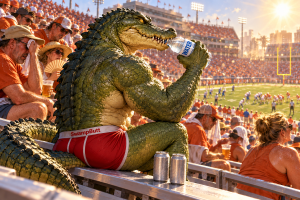
Those results do not establish that our climate-conditioning approach provides a dependable predictive advantage. But they do not refute them either. “The ‘scale is not science or even scientific,” Heraldson said. “We want to demonstrate the tendency for teams from the hotter and more humid places to likely be in better shape than those who are not. Plus for people who go to the games, what they should plan for. Like drinking water instead of beer. Or eating lighter snacks in place of beer. Or wearing a hat instead of beer, to keep the sun from baking your brain.”
Still Gonna Predict Games
The predictions remain an experiment within the project. Our public coverage will place greater emphasis on the people experiencing the conditions: fans, marching bands, stadium workers and players. When reliable medical-response figures are available, we will distinguish patient contacts, heat-related cases and hospital transports rather than treating them as interchangeable.
The Scale is not a medical warning system, and a ‘scale’ score cannot determine whether an individual is safe. Fans should follow official weather alerts and venue guidance. Our purpose is to make the conditions easier to understand and bring documented experiences into the conversation. “A satisfying football Saturday includes being able to enjoy the game and get home safely. That is an outcome worth paying attention to every week,” Heraldson concluded.
From Fabric Drying to Football
SwampButt Underwear developed the Scale to explore how weather affects moisture evaporation and fabric drying, including comparisons between its specially treated Lycra/Spandex and traditional underwear fabrics. The football project extends that idea into a test of possible climate-conditioning advantages.
The Scale’s football picks are intended for entertainment, not betting advice. Its ratings do not replace official weather alerts or venue heat-safety guidance.
About SwampButt Underwear
SwampButt Underwear is a Lake Jackson, Texas-based men’s underwear brand designed to help manage moisture and improve comfort in hot, humid conditions.
SwampButt Underwear™ is a real company with a product that helps solve a problem, that being visible sweat on a man’s backside. SwampButt Underwear is for people who experience excessive perspiration, uncomfortable dampness and visible butt sweat. The company’s performance underwear is designed to move moisture away from the skin, dry faster than traditional cotton underwear and reduce the discomfort associated with heat, humidity and physical activity.
SwampButt Underwear™ is based in Lake Jackson, Texas. SwampButt Underwear™ is a registered trademark in the United States and other countries. We paid a lot for it so only use it with permission.
Sidebar: How the Scale Works
- The Rating: It ranks weather conditions on a numeric scale from 1 (not sultry at all) to 10 (unbearably sultry, like Singapore or Clute, TX). [1]
- The Inputs: The tool combines game-time temperature, relative humidity, wind speed and direction, cloud cover, precipitation, and estimated fabric-drying conditions. [1, 2]
- The Purpose: Originally designed to help fans decide what to wear, it has humorously expanded to predict how well-conditioned hot-weather teams are compared to moderate-climate teams, even attempting to predict college football game outcomes. [1, 2]
PHOTO CAPTION: people who go to the games, can look to the scale for what they should plan for on game day. Like drinking water instead of beer. Or eating lighter snacks in place of beer. Or wearing a hat instead of beer.